PRESSURE SWING ADSORPTION
Pressure Swing Adsorption (PSA) – For your gas purification work, get your pressure swing adsorbents from a manufacturer and supplier who gives you more. With UNICAT Catalyst on your side, you can get all of the newest purification and gas separation technologies you need with spectacular customer service and competitive prices.
Pressure Swing Adsorption (PSA) is a well-established gas separation technique in hydrogen purification, air separation.
The adsorbent materials selected and employed in the PSA process are extremely important as well as proper engineering to improve the performance of a PSA unit.
UNICAT offers a premium range of pressure swing adsorbents and a deep technical understanding in engineering PSA systems to lead our customers to the best PSA performance possible.
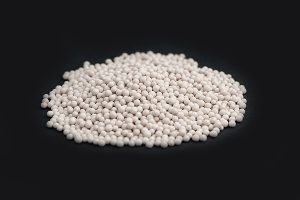
PRODUCT BENEFITS
- Extended adsorbent life
- Higher purity hydrogen produced (99.99%) – high hydrogen recovery (90%)
- Hydroprocessing Units – Increased run time
- Downstream catalyst poisoning avoided
- SMR (Steam Methane Reformer) – The many benefits of Magcat® Catalysts embedded with PSA elements do (Increased Production, Methane Slip)
PRODUCT STEPS
I. ADSORPTION [ADSO]N
The adsorption phase is operated at high and constant pressure. This is determined by the pressure of the feed. The goal is the enrichment of the less selectively adsorbed species in the gas phase in the product. In this phase, the most rapidly adsorbed species such as H2O, Hydrocarbons, N2, CO2, and CO are selectively adsorbed. During the ad–sorption step, the feed valve as well as the H2 product valve remain open delivering high purity H2. Once this step is finished the depressurizations steps will follow.
II. EQUALIZATION [EQ]
The high and low-pressure beds are connected through their product ends. The main purpose of the Equalization step is to conserve mechanical energy that is contained in the gas of the high-pressure bed, as well as preserve part of the separation carried out in the high-pressure bed. With this step, blowdown reduce losses, with consequent improvement in the recovery of the product.
III. PROVIDE PURGE [PP]
The provide purge is a depressurization step in concurrent direction to purge or regenerate another absorber with a rich H2 stream during its regeneration phase.
IV. BED BLOWDOWN [BD]
The Bed Blowdown is the first step in which Tail gas valves are open and releases the impurities by the depressurization phenomena.
V. RECEIVE PURGE
Receive Purge is the final stage to clean the beds. A flow from another adsorbate in the Provide Purge step is used to final purge and regenerate the bed, directing all remaining contaminants to the tail gas system.
VI. REPRESSURIZATION [REP]
Since the adsorption step is carried out at high pressure, the bed must first be repressurized. This is done by using streams coming from other adsorber beds in their equalization step.
VII. FINAL REPRESSURIZATION [FR]
The last part of the repressurization is called Final Re–pressurization. This is either done by feed or H2 product
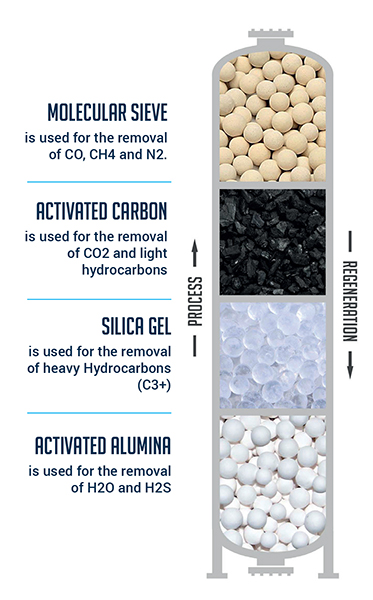
LOADING DIAGRAM
There are a significant number of contaminants that require removal from a standard gas stream. Different layers of adsorbents are commonly used to remove one or more targeted contaminants. Process steps are upflow while the regeneration steps are downflow.

AFS UNIQUE FEATURES
- Available from the ultra large 60 mm ID down to miniature 3 mm ID filter
particle for exceptional size grading. - Available in promoted type for mild HDS hydrogenation, silica removal and
dernetalization. - High crush and physical strength provides minimal dusting and breakage during loading and unloading.
- Available from 10 mesh to 50 mesh filter patterns in most sizes providing exceptional flexibility in design.
- Available with active Surface Area exceeding 60 M2/g to 110 M2/g so it can be used as catalyst substrate while maintaining filtration capability.
- Well suited for high pressure applications such as CFH, GOHT and HCU reactors as well as less severe applications such as NHT and DHT.
INNOVATION IN DESIGN
The Next Generation of AFS has improvements in geometry. The shape and design has evolved along with a deeper understanding of dynamics which influence filter capacity and pressure drop.